Opening Cohort 1
After eighteen months of building, running, and breaking Maren in our own business, Cohort 1 is opening in the coming …


Walk into any AI marketplace this year and the pitch is roughly the same: here is a roster of agents. One for sales, one for marketing, one for support, one for ops. Hire your team. Send each one a task. Watch them go.
It looks like productivity. It is fragmentation in a fresh paint job.
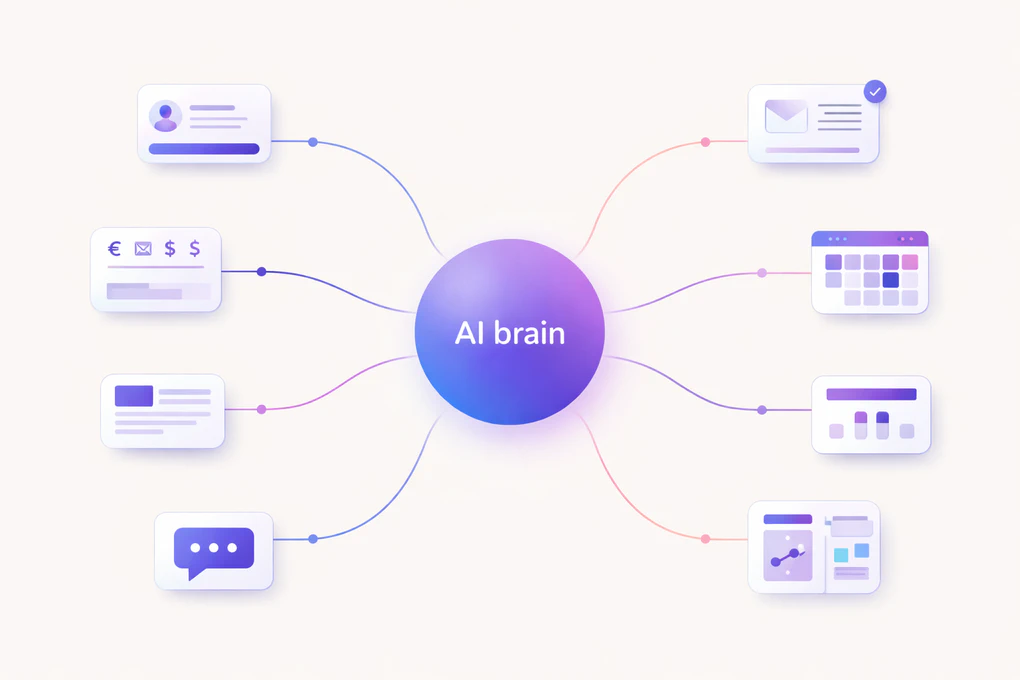
We chose the opposite shape on purpose. Maren is one AI. She runs every part of your business from one conversation, one memory, one audit log. The variety lives in the skills you install on top of her, not in the people pretending to be agents on a dashboard.
Three reasons that decision is the whole product.
When you talk to a “sales agent” about closing the Ellenbrook deal, then switch to the “ops agent” to send a follow-up invoice through Xero, you have just had two separate conversations with two separate brains. Neither knows what the other knows. You explain the deal twice. Or three times. Or you give up and copy-paste between tabs because the friction is not worth it.
Maren does not partition. The same conversation that planned the deal is the conversation that drafts the invoice. The follow-up email she writes references the chat from last Tuesday because it was the same chat. Sales context lives next to ops context lives next to the financial reality. That is how a real team works. That is how an AI teammate should work.
Multi-agent systems are forced to share state through APIs and prompt stuffing. Every “agent” maintains its own session, its own context window, its own plausible deniability when something goes wrong. The result is the same memory problem chatbots have had for two years, dressed up in nicer org charts.
Maren has one memory. Append-only. Permanent. Every conversation, every workflow she runs, every document you upload, every lesson she captures from a successful or failed run lives in the same searchable register. Ask her about a client conversation from six months ago, and she finds it in seconds, because there is no agent boundary to cross.
The longer you use her, the more she knows. Week one she is a capable assistant. Month six she understands your business better than most of your team. Year two she spots patterns you have never seen. That compound only works if there is one brain doing the compounding.
The case for multi-agent systems usually comes down to specialisation. A marketing agent knows marketing. A sales agent knows sales. Surely separation produces better answers.
In practice, you end up managing the manager. Each agent has its own prompts, its own quirks, its own permissions. You spend more time orchestrating the swarm than getting work done.
Maren installs skills the way you install apps on your phone. Want content generation? Install the marketing skill. Need ad management? Install that one too. They share the brain, share the memory, share the audit log. They compose, so the more skills you add, the more she runs autonomously without supervision. You scale capabilities without scaling cognitive overhead.
There are real architectures where multi-agent makes sense. Building a research engine that needs adversarial debate. Designing a system where compartmentalisation is a security requirement. Modelling environments where agents represent different stakeholders.
A small business is not one of those environments. Your business is one organisation, with one set of clients, one set of priorities, and one owner trying to keep all of it in their head. The AI that helps you should be shaped the same way.
That is the bet behind Maren. One brain. Modular skills. A memory that compounds. We will know in twelve months whether it was the right one.
After eighteen months of building, running, and breaking Maren in our own business, Cohort 1 is opening in the coming …

If you run a small business in Australia, you have probably noticed every AI product you trial is hosted somewhere else. …
Cohort 1 opens in the coming months. Get on the waitlist to lock in founding pricing,
shape what ships first, and be first in line when invites go out.