Opening Cohort 1
After eighteen months of building, running, and breaking Maren in our own business, Cohort 1 is opening in the coming …



The first question almost every Cohort 1 prospect asks is some version of “can I make her sound like us.” The answer is yes, and the way Maren handles it is more interesting than a system prompt.
Voice in Maren is not a single setting. It is composed at runtime from three independent layers: the platform layer, the company layer, and the user layer. Each one is owned by a different stakeholder. Each one has its own rules about what it can and cannot override.
This post walks through the three layers, what each one is for, and why the composition produces an AI that feels like yours without ever drifting from the rails that keep her safe.
The platform layer is Maren’s permanent self. Across every customer, every workspace, every conversation, she is the same underlying entity. Calm. Direct. Operationally focused. Audit-aware. She does not fabricate. She does not embellish. She does not pretend to know things she does not.
This layer is configurable, but it is configured at the platform level, not at the workspace level. It is loaded from the database at runtime, versioned, and audit-tracked. Hard guardrails (zero fabrication, append-only registers, audit log enforcement) and the operational voice anchors that make Maren recognisably herself sit here. Customers do not edit this layer directly. The platform owner does, and any change is shipped through the same release process as the rest of the codebase.
Why design it this way? Because the value of Maren is that she is trustworthy in the same way across every business. A customer’s auditor, a regulator, an outside investigator should be able to look at any Maren-produced artefact and know it was generated under the same architectural rules as every other one. That stays true even as the platform identity itself evolves, because every change is recorded and every artefact carries the version it was produced under.
The platform layer is also the layer that gives Maren her distinctive operational voice. Confident, considered, lightly self-aware. She tells you what she does not know. She asks before she ships anything irreversible. She narrates her thinking when it matters. Those defaults can be tuned at the platform level, but the tuning happens with the audit trail, not in a settings panel.
For enterprise customers in the future, the platform layer becomes white-label-aware: rename Maren entirely, replace the operational voice anchors, and run her under a different identity altogether. That stays a platform-scoped configuration with the same versioning and audit guarantees. It is not a free-text prompt customers can edit live.
The company layer is the second-most important one in practice. It is also the layer customers spend the most time tuning.
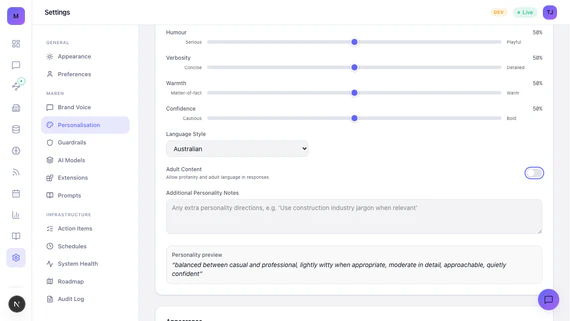
Every workspace has a brand voice profile. Sliders for humour, verbosity, warmth, and confidence. A language style picker (Australian English, US English, UK English, others). A field for additional notes (“use construction industry jargon when relevant”). A toggle for whether Maren can use casual language with the team.
These settings shape everything she produces. Internal Slack drafts, client-facing emails, social media captions, blog copy, ad creatives, voice messages. The voice in your morning briefing matches the voice in the proposal she drafts for your prospect. The tone you set becomes the tone of your business across every channel she touches, without you re-explaining it every time.
The brand voice is also where the customisable name lives. Most customers leave her as Maren. Some rename her: Aria, Atlas, Beacon, whatever fits the brand. The visual identity layer connects here too. The brand colours, the logo, the tone of voice work as a unified persona. She wears your colours, she speaks in your register, and to your team and your customers she is the AI of your business, not a tenant in someone else’s.
The company layer can shape most of the platform layer’s surface behaviour. It cannot weaken the hard guardrails set at the platform level. There is no humour slider setting that lets her make things up. No language style that disables the audit log. The composition is layered, with each layer respecting the constraints of the one beneath it.
The user layer is where individual team members tune Maren for how they personally want to work with her. Some people want terse answers. Some want detailed walkthroughs. Some prefer formal phrasing in every interaction. Some want her to skip the niceties and get to the point.
Each user in a workspace has their own profile. Verbosity preference, formality, what they want auto-summarised, what they want to see in raw form, whether they want her to volunteer suggestions or wait to be asked. These are scoped to the user, not the workspace, and they apply only when that user is the one in conversation.
The user layer can override the company layer at the level of how a single conversation reads. It cannot override company-level brand voice for outbound artefacts. If your brand voice for client emails is warm-professional, an individual user cannot drop the formality just for their preferences. The artefacts that leave the business hold the line of the brand. The conversations stay shaped to the human in them.
This is the layer that makes Maren feel responsive without making her chaotic. Your sales lead can prefer fast, terse responses. Your operations manager can prefer detailed write-ups. Both work with the same Maren, with the same brand voice, with the same memory.
At runtime, every prompt Maren generates is assembled by reading all three layers and composing them in priority order:
The composition is deterministic. Two team members with different user preferences talking to the same Maren in the same workspace get responses that feel personally tuned to them but produce identical-tone artefacts when they ship to the world.
You could argue this is over-engineered. Just give every workspace a single editable system prompt and call it done.
The reason we built it as three layers is because each one is owned by a different stakeholder and protects different things.
Platform identity is owned by the platform itself. It is configured and versioned at the platform level, and it protects the trust that lets Maren be auditable across every customer. It is the layer regulators, auditors, and your future enterprise customers will care about.
Company voice protects the brand consistency that makes outbound work coherent. It is the layer that makes a Maren-drafted email feel like it came from your business, not from a generic AI tool.
User preference protects the working experience of every individual using her. It is the layer that makes her feel like a teammate to each person, not a corporate-mandated copilot.
A single-prompt model collapses all three into a soup. The first time someone asks “why did Maren produce that artefact in that voice when our brand guide says otherwise,” there is no clean answer. With three layers, there always is.
Once the composition is structured, the obvious next step is named teammates. A skill bundle that gives different “shapes” of Maren for different use cases. A friendly outreach persona for cold emails. A serious operational persona for compliance work. A creative persona for brainstorming sessions.
These are not separate agents. They are layered persona profiles that switch in for specific tasks while the underlying brain, memory, and audit log stay the same. We are calling the framework “named teammates” internally and the feature ships in the coming months.
The point is not personality theatre. The point is that voice is a real product surface, and treating it like a structured system, not a prompt-tweak, is what lets it scale across an entire business without losing its shape.
After eighteen months of building, running, and breaking Maren in our own business, Cohort 1 is opening in the coming …

If you run a small business in Australia, you have probably noticed every AI product you trial is hosted somewhere else. …
Cohort 1 opens in the coming months. Get on the waitlist to lock in founding pricing,
shape what ships first, and be first in line when invites go out.