Why one AI beats ten
Walk into any AI marketplace this year and the pitch is roughly the same: here is a roster of agents. One for sales, one …

The single most exhausting thing about working with chatbots is that they forget. Every session is a blank page. You spend the first five minutes re-explaining who your clients are, what you tried last week, and why this particular email needs a careful tone.
Maren is built on a different idea. She remembers everything you have ever told her, every document you have uploaded, every workflow she has ever run for you. Ask about a client chat from six months ago, and she finds the line you wanted, with the date and the context attached.
This is not a bigger context window. It is not a vector store stapled onto a chat UI. It is a deliberately designed memory architecture, and the choices we made along the way are the reason the longer you use Maren, the sharper she gets.
The core of Maren’s memory is a simple rule, applied without exception. Nothing in the knowledge base is ever updated. Nothing is ever deleted. When a fact changes, the old fact stays where it was, and a new entry is written that supersedes it via a supersedes_id link.
That sounds like a technical detail. It is actually the entire trust contract.
It means: when Maren tells you something today, you can ask her tomorrow how she knows it, and she can show you the exact register entry, the workflow that produced it, the conversation that confirmed it, and any superseding entries that have refined it since. Nothing is lost. Nothing is silently overwritten. The audit trail is the data.
It also means: if a client tells you in March they prefer Tuesday meetings, and in October they change their mind, both facts live in the register. The October entry supersedes the March one for current decisions, but the history is intact for context. Maren can tell you “they used to prefer Tuesdays, then switched to Thursdays in October.” That is a level of nuance flat-overwrite memory cannot offer.
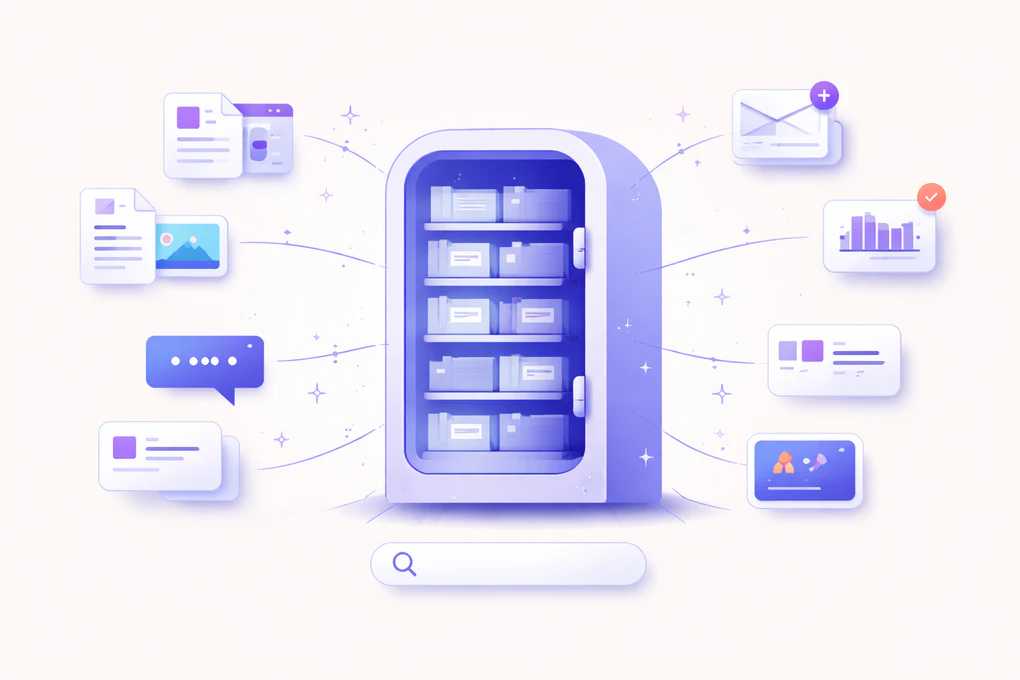
What goes into memory matters as much as what stays. PDFs, contracts, screenshots, voice notes, social posts, ad creatives, ledger entries from Xero, conversations from Microsoft 365. All of it lands in the same register, indexed and tagged.
Behind the scenes, multimodal models like Gemini handle the document and image extraction. The output is structured: facts, entities, relationships, dates. Those structured outputs are what Maren actually retrieves later. Not the raw blob, the parsed knowledge.
When you ask “what did Sarah from Nguyen Coaching say about the rebrand timeline,” Maren finds the answer because she captured it as a fact about a specific contact in a specific conversation, not because she is doing similarity search over a wall of text.
Memory is not just facts. It is the lessons your business has paid for. Every workflow Maren runs writes an outcome entry. What she did, what worked, what failed, what surprised her. That self-learning log feeds back into her decision-making for similar tasks.
Run the same proposal-drafting workflow ten times, and by run ten she has noticed the patterns: which clients respond to a particular tone, which pricing structure has lifted close rates, which day of the week your invoices get paid fastest. None of that is hardcoded. It compounds because the system is built to compound.
Retrieval-Augmented Generation became a buzzword in 2023, and most AI products now claim “long-term memory” through some form of vector embedding store. The differences in how those stores are structured matter.
Most implementations are either flat (every chunk is independent, retrieval is fuzzy) or session-scoped (memory expires with the conversation). Both produce a chatbot that “kind of” remembers things, but cannot reliably tell you why or when.
Maren’s register is entity-centric. Every contact, every deal, every project, every recurring client interaction has its own thread of history. Retrieval is structured: you do not get the closest fuzzy match, you get the actual entries about that exact thing, in chronological order, with provenance.
It is the difference between an AI that can produce text about your business and an AI that knows your business.
Week one with Maren feels like a capable assistant. She helps you draft an email, summarises a PDF, runs a workflow you set up.
Month six, she opens the morning briefing with context you forgot you mentioned. She catches an inconsistency between what a client said in March and what they said in October. She notices a campaign performance pattern across two industries.
Year two, she spots the strategic patterns you have not articulated to yourself yet. The reason that works is the architecture, not the model. Bigger models do not give you institutional memory. The memory has to be structured, append-only, and continuously fed by every workflow she runs.
That is why we built it the way we did. The product is the memory.
Walk into any AI marketplace this year and the pitch is roughly the same: here is a roster of agents. One for sales, one …
After eighteen months of building, running, and breaking Maren in our own business, Cohort 1 is opening in the coming …
Cohort 1 opens in the coming months. Get on the waitlist to lock in founding pricing,
shape what ships first, and be first in line when invites go out.